How therapy fails high net worth clients
Generalist therapy or counselling training rarely prepares a therapist for the complexity of significant wealth. Trauma and Intensives Specialist Therapist, Lucy Orton, on where it tends to fall short.
Most counsellor and therapy programmes and courses prepare the clinician for working with the general population, not specialising within tiny niches within the whole. Common presenting issues, familiar life circumstances, a fairly predictable range of what walks through the door.
However, a life with financial abundance, complexity, and often global living, doesn't sit neatly inside that ‘within normal’ range.
Multiple businesses, significant assets to manage, complex family structures, advisors, board seats, visibility: all of this brings a unique set of pressures. And a therapist experienced only in the general population can accidentally fall short, not because the client is inherently different on a human-to-human level, but because the training often doesn’t take the daily nuanes facing this subpopulation into account.
Here's the difference in practice.
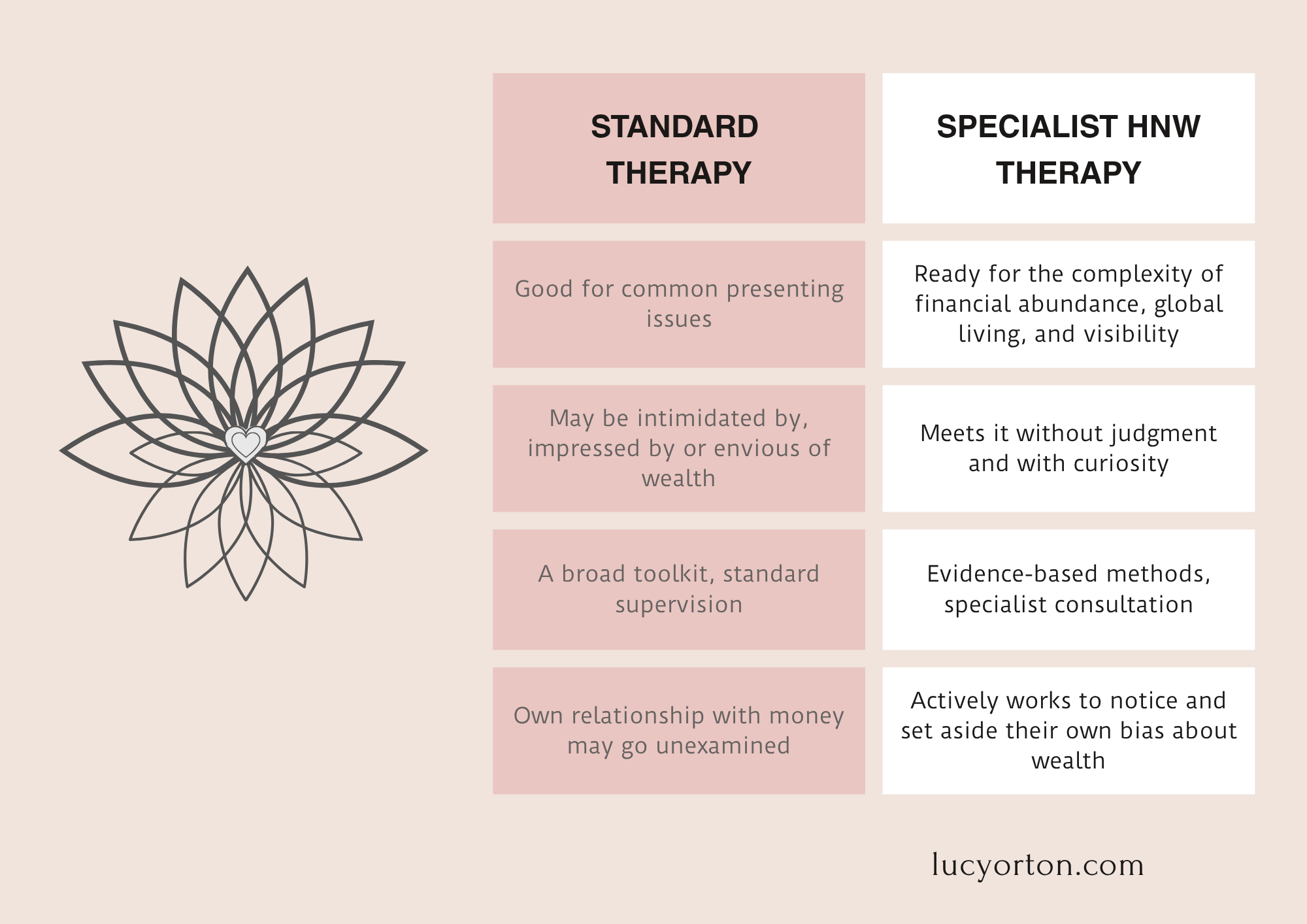
How specialist high net worth therapy differs from a generalist approach.
A generalist therapist is well prepared for common presenting issues. Complexity at real scale, financial, professional, relational, sits outside most standard training entirely and can feel daunting. That differential tends to show up in one of two ways in the therapy room: the therapist is either intimidated by what they're hearing, or oddly impressed by it. Neither stance helps the work.
A generalist toolkit can also mean a broad, somewhat improvised approach, a bit of this, a bit of that, rather than a named method chosen because it's suited to the material and the needs of the client in question. IFS and Brainspotting are structured, evidence-referenced approaches, chosen here specifically because they can hold real complexity and get to the crux of matters that haven’t shifted until this point.
Confidentiality matters differently at this level too. Standard confidentiality is the ethical baseline every therapist works within. Watertight confidentiality, alongside extra reassurances (such as NDAs) is a stronger, more specific version of that, required for people whose privacy concerns are more compelling and crucial than most.
In addition to the above, there is another key issue which often gets forgotten. The therapist carries their own relationship with money and wealth, shaped by their own life, their own upbringing, their own feelings about people who have more or less than they do AND their own position in an industry of helpers and healers.
When therapists leave this aspect of the therapy room dynamic unexamined, that can distort the work, in the direction of judgment, minimising, envy, or even an unconscious wish to please. A therapist properly equipped for this work has done the harder task of noticing their own biases and blocks about wealth and setting it aside, so the work stays about the client, not about what their wealth stirs up in the person sitting across from them.
Many people are well served by generalist therapy. High net worth clients often aren't which is a mismatch worth noticing and considering carefully, for both the therapists who work with the HNW client population and those clients themselves, when choosing therapeutic care that can fully meet their needs.
Read more about therapy for high net worth individuals here →