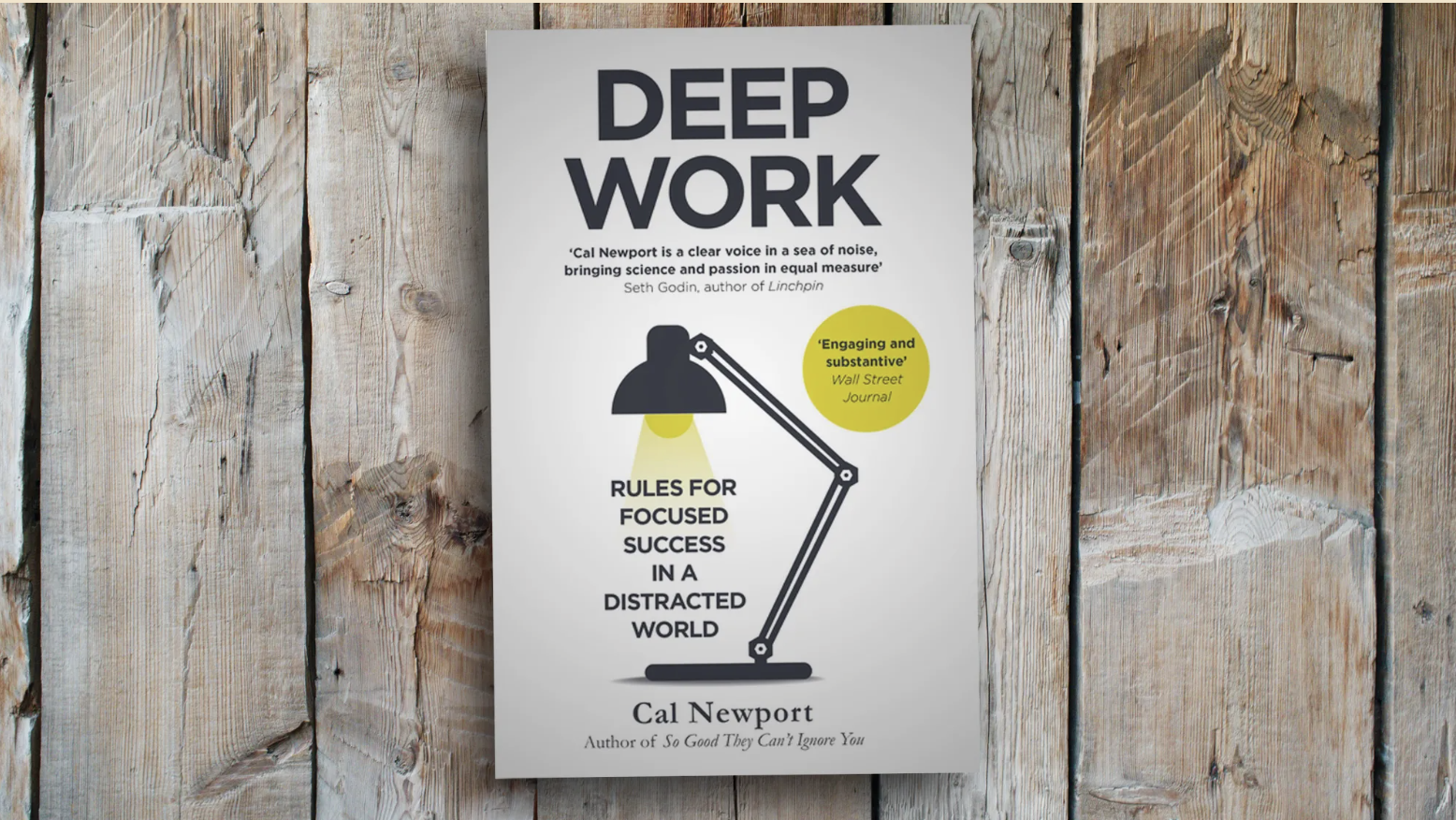
Cal Newport's philosophy of focused, uninterrupted work explains more about your inner life than you might expect. (Image credit: www.itsmoreofacomment.com)
There is a particular kind of person who picks up Cal Newport's Deep Work and feels, on some level, seen.
They are high-achieving. They are serious about their time.
They have likely built something impressive, or are in the process of doing so, through sustained, deliberate, focused effort. They understand, intuitively and through hard-won experience, that scattered attention produces shallow results. They know the difference between being busy and actually getting somewhere.
Newport's central idea is simple and, to most people, quite surprising: the ability to focus without distraction on a cognitively demanding task is one of the most valuable skills of our era AND one that most people are systematically failing to cultivate.
IMPORTANT NOTE:Much of Newport’s argument assumes something about how attention operates: that depth is broadly accessible through discipline, environment, and protected time. That's true for a lot of people. However, it isn't true for everyone and I believe neurodivergence needs to be considered in this topic fully. If the idea of ‘just clear your calendar and focus"‘has never quite been your experience, particularly if you're ADHD or autistic, this piece on hyperfocus and depth might be the more useful starting point.
Deep work, as Newport defines it, is not just about productivity. It is about the quality of engagement with what matters most. Surface-level effort, applied even consistently over years, will not get you to mastery. Only depth will.
If you have read Newport's book and found yourself nodding, this post is for you. Because there is something else you may have already clocked: the same logic that explains why deep work produces exceptional professional results also explains why shallow therapeutic engagement rarely produces the lasting personal change you are looking for.
The Problem with the Weekly therapy Hour
The dominant model of therapy, one fifty-minute or an hour-long session per week, was built for a different era and a different set of clients (well, actually it was also built for insurance, but that’s a different story for another post!).
For many people it is useful. But for high-performers, ambitious professionals, and anyone who has already done enough reading, podcasting, coaching and journaling to know that something deeper needs to shift, weekly therapy often replicates the very problem Newport identifies: it is context-switching disguised as progress.
You arrive carrying the week. You spend the first fifteen minutes getting back into the material. You begin to touch something real, then the hour is over. You return to your life. By next week, the thread has partially dissolved. You pick it up again. You make some progress. The hour ends.
This is not bad therapy. It is, however, slow therapy, and therapy in which it can be hard to go deep. And for certain kinds of change, particularly the kind that requires getting underneath the intellectual understanding you already have of your own patterns, slow may not serve you.
Newport distinguishes between deep work and shallow work not in terms of effort but in terms of cognitive depth and continuity. Shallow work, performed quickly and with frequent interruption, has its place. But it cannot produce what only sustained, unbroken engagement produces. The insight that changes your professional trajectory and the insight that changes your relationship with yourself both require the same thing: enough uninterrupted time to go somewhere you have never been.
What Depth Means in a Therapeutic Context
The modalities I work with, primarily Internal Family Systems (IFS) and Brainspotting, are not light-touch approaches. IFS asks you to turn towards the parts of yourself that have been managing, protecting, or carrying pain for decades. Brainspotting accesses and processes trauma held in the subcortical brain, beneath the reach of language and intellectual narrative. Neither of these processes reaches its full power in fifty-minute instalments.
This is not a criticism of weekly work. It is an acknowledgement of what depth requires.
In IFS, the real movement happens when a part feels safe enough to unburden. That level of safety takes time to build within a single session, not just across sessions. In a typical weekly hour, by the time you have arrived, oriented, and opened the internal world enough to actually meet a part, you are already approaching the end. What could have been a profound unburdening becomes, instead, a meaningful but partial conversation. The part retreats. You close up. You go back to your week.
In an intensive format, something different becomes possible. The nervous system has time to settle. The parts have time to trust. The process does not have to be managed against the clock. The therapist holds the space without watching the minutes. And the client, freed from the constant interruption of weekly re-entry, can actually go somewhere.
The Intensive as Deep Work for the Self
Newport writes about the importance of ritualising deep work: carving out protected time, removing distraction, committing fully to the task, and then producing something that could not have been produced through scattered engagement.
An intensive is exactly this, applied to the our inside world, our internal life.
When a client comes to work with me for one, two, or three days, they are making a Newport-style commitment to depth. They are saying: this cannot happen in the margins. This deserves protected time. I am going to go fully into this, without half my attention on what I am returning to afterwards.
The results reflect that commitment.
What might take years of weekly sessions to surface and process can become accessible in the concentrated container of an intensive. Not because the intensive is faster in a superficial sense, but because continuity and depth produce conditions for change that fragmented contact simply cannot. The nervous system learns that it has enough time to be honest. The protective parts learn that they do not need to manage the clock. The process can actually complete, rather than being repeatedly interrupted at its most alive moments.
This is true of the online intensives I offer, where clients work across multiple sessions within a condensed period. It is even more profoundly true of in-person retreat intensives, where the removal of ordinary environment adds another layer of permission to the process. Being outside your daily life, physically, communicates something to the system that weekly drop-ins cannot: we are here for this now, not in between everything else.
Who This Is For
Not everyone is ready for intensive work. Weekly therapy has its place, and there are stages of the journey where building a slower, more relational foundation is exactly right.
But if you are the kind of person who has read Deep Work and rearranged your professional life around its principles, there is a good chance that a particular kind of frustration is also familiar to you: the sense that you understand your patterns intellectually but cannot seem to shift them at the level that would actually change your life. You know the narrative. You can explain your attachment style. You have done enough CBT to spot your cognitive distortions in real time. And yet.
That gap, between intellectual understanding and embodied change, is precisely what intensive work is designed to close. Because it is not a knowledge problem. It is a depth problem.
You already know, in the Newport sense, that surface-level engagement with the most important things does not produce what matters. You have applied that understanding to your career, your craft, your creative output. Now apply it to yourself.
Working With Me
My practice is built around depth. I work with high-achievers, ambitious humans, and people who have tried other approaches and know they are ready for something that goes further. I also structure my own working week in a way that honours, depth, intensity, rest and integration - this is intentional design, both for me and for the clients I work with.
Online intensives offer one, two, or three days of focused IFS and Brainspotting work, conducted across extended sessions within a compressed timeframe. Clients come from across the globe. These are not marathon sessions that exhaust you. They are structured, well-paced containers that give the process enough room to actually move. Investment from $4,500 per full day.
In-person retreat intensives take this a layer further. Arriving in person and stepping outside your ordinary environment gives the system permission to drop its guard in a way that even the best video call cannot replicate. The ordinary armour of daily life does not travel as easily. These intensives are held in Southeast Asia and, for the right client, represent some of the most profound work I offer.
If any of this lands, and if some part of you recognises that you have been doing the equivalent of shallow work on your inner life for long enough, I would love to have a conversation.
You can learn more about my approach to intensive work here or book a free consultation directly here.
The depth is available, all you need is the right conditions and intention for it to become accessible.
Lucy Orton is a registered counsellor, intensives specialist therapist, and certified coach specialising in IFS, Brainspotting, and trauma-focused deep 1:1 work and retreats. She works with individuals globally online and in person across Southeast Asia.