INTERNAL FAMILY SYSTEMS: WHAT’S IFS REALLY ALL ABOUT?
A visual explainer post exploring the life-changing IFS modality
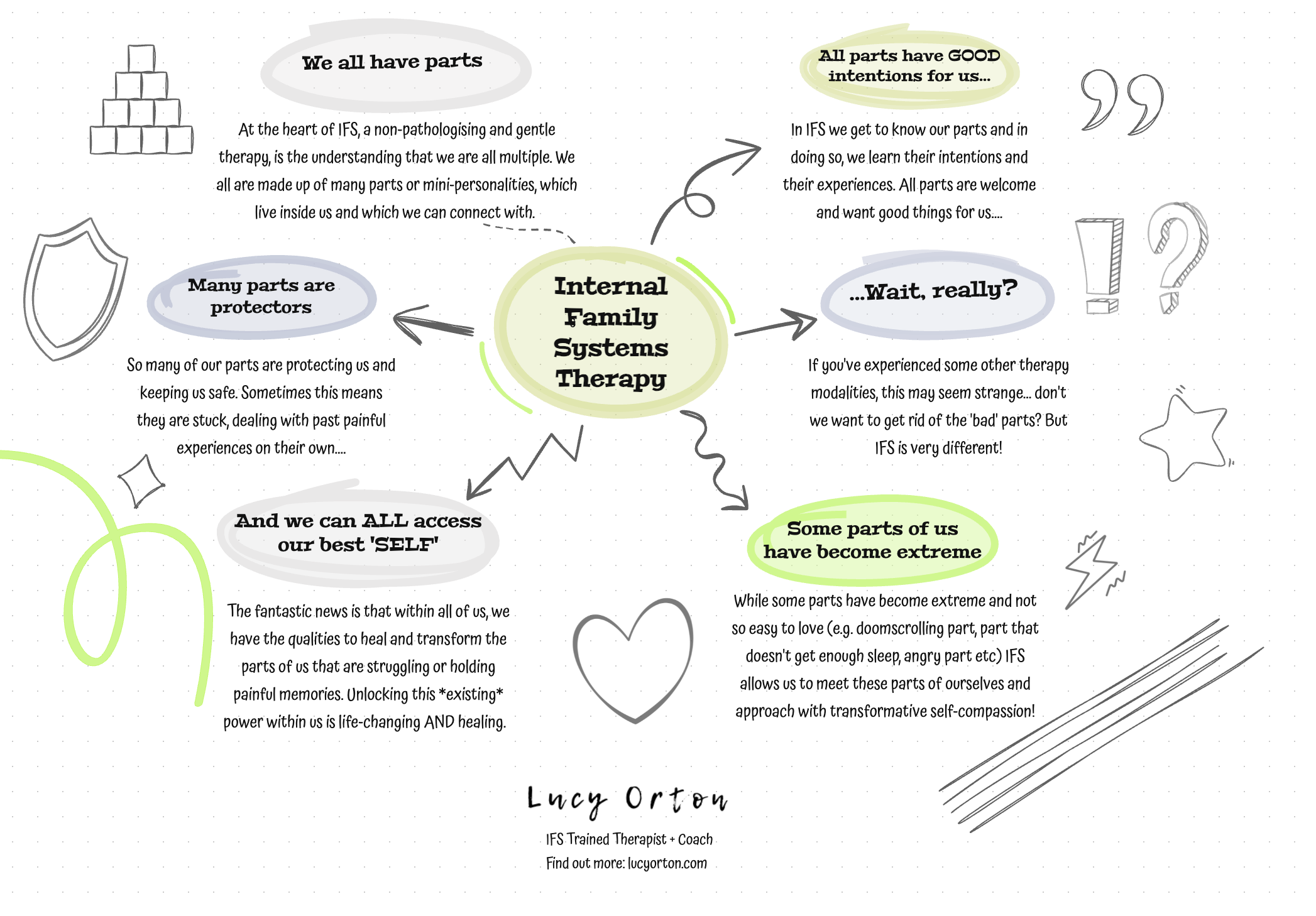
Feel free to share this image explaining key elements of Internal Family Systems Therapy (IFS).
Copyright: Lucy Orton 2024

The image above is my own mind map of the core elements of Internal Family Systems therapy — feel free to save it and share it. If you'd like to explore IFS in depth, you can read more about how I work with IFS here.
WE ALL HAVE PARTS
At the very core of IFS is a deceptively simple idea: you are not one thing.
You are not your worst moment, any more than you are your highlight reel.
You are complex, multiple, and, in IFS, beautifully so.
The easiest way to feel into this is to think about the times you've felt pulled in two directions. Do I go to the gym or eat the entire packet of biscuits? Both of those impulses are real.
In IFS, we call them parts. You have a gym-goer part and a biscuit-lover part, and both have something to say. Both want to help in some way.
MANY PARTS ARE PROTECTORS
A lot of our parts took on specific roles early in life, and they've been working very hard ever since.
Perfectionist parts. Striving parts. The part that worries you're not up to the task. The part that pushes you to keep going long after you're exhausted. These parts developed for good reasons, and they are loyal to a fault.
Sometimes we're grateful for them. Sometimes they drive us, and the people around us, a little up the wall. Often both.
ALL PARTS HAVE GOOD INTENTIONS
Here's where IFS gets genuinely radical: every single part of you, including the ones causing you the most trouble, has a positive intention toward you.
The inner critic that tells you you're not enough?
It's trying to protect you from failure, rejection, or humiliation.
The part that numbs out or withdraws?
It learned that was the safest thing to do.
This doesn't mean the behaviour is helpful. It means the part deserves curiosity rather than all-out war.
WAIT — I SHOULDN'T WANT TO GET RID OF MY DIFFICULT PARTS?
If you've done therapy before, especially CBT or DBT, this can feel strange at first. Surely the goal is to eliminate the parts causing problems?
IFS takes a different view entirely.
The framework, developed by Dr Richard Schwartz, is built on the belief that we have no bad parts. In your IFS work, rather than fighting your inner world, you learn to turn toward it.
Clients often describe moving from feeling at war with themselves to experiencing a genuine sense of inner harmony and self-compassion.
SOME PARTS HAVE BECOME EXTREME: THAT'S WHERE THE REAL WORK HAPPENS
When parts have been carrying heavy burdens for a long time, they can become extreme in their behaviour. These are the parts that are hardest to be with AND the ones that need the most care.
In IFS, we approach these parts with curiosity and compassion rather than trying to shut them down. We listen to their stories. And when the time is right, we offer them the space to unburden, evolve, and step out of the extreme roles they've been holding.
This is some of the most profound therapeutic work I do with clients.
THE SELF: YOUR GREATEST INNER RESOURCE
Underneath all the parts is something IFS calls the Self. It’s a calm, compassionate, curious core that exists in every single person, no matter how much pain they've been through.
You can read more about Self Energy and what it feels like to access it here.
Working with an IFS therapist means learning to bring Self-Energy into relationship with your parts — and that's where lasting transformation happens.
READY TO EXPERIENCE IFS FOR YOURSELF?
IFS is one of those modalities you really have to feel to understand. The theory is fascinating, but the experience is something else entirely.
If you're curious about working with IFS in depth, I offer IFS-informed therapy intensives for high-achievers, founders, and people who are ready to do meaningful work in a concentrated, immersive format. You can find out more about how I work here.
If you'd like to arrange a free 20-minute consult to explore whether we're a good fit, you can do that here.
I look forward to connecting with you.
Lucy Orton IFS Therapist | Therapy Intensive sSpecialist